

- ModeSens /
- Designers /
- Home /
- Pre-Owned Home
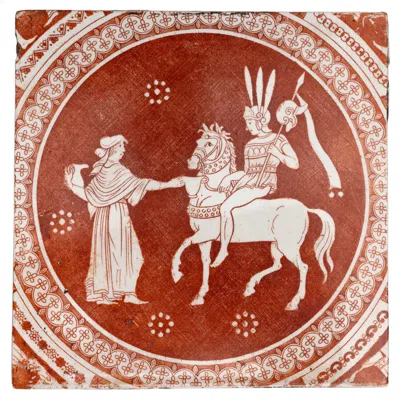
Pre-owned Early Red Greek Pattern Tile
- Size:ONE SIZE
- condition:Pre-Owned
- price:$1500
Set Alert
For Sale On

Shop Concierge
ModeSens Before You Buy
Don’t miss out! Compare prices across 950+ vetted stores, all in one place. Plus, earn rewards every time you shop.
Join over 2M members today!
product description
A Neoclassical red transferware tile made by Spode 1806-1810, with the ‘Refreshments for Phliasian Horseman’ pattern. Sir William Hamilton’s Collection of Etruscan, Greek and Roman antiquities, first published in 1766 by Pierre d’Hancarville, was a landmark publication in English design. It intended to disseminate the Antique style through its engravings of Attic pottery. The catalog’s faithful reproductions of Classical vases led British potteries, including Spode, to adapt or even copy the ancient art for modern life. These Spode Greek pattern tiles reflect the major influence of Hamilton’s catalog on English Neoclassicism. The central scene was taken directly from the catalog. This tile can be dated to a narrow window of production in the Spode factory, 1806-1810. During that time, Spode used a technique known as the "Pluck and Dust” method to print in red transfer designs onto creamware. Using this method, source prints were transferred overglaze using tissue imprinted with a very faint rendition of the design outlined in sticky oil. The decorator applied the tissue to the object then carefully "plucked” or pulled it away, leaving the sticky oil design behind. Then, a finely-ground enamel color was "dusted” onto the surface, sticking to any areas that had the oil. A final firing at a low temperature in the enamel kiln made the pattern permanent. The Pluck and Dust technique improved upon bat-printing and enabled larger designers to be transferred. It was short-lived, however, as under-glaze transfer printing soon took over as the preferred method for producing transferwares. Dimensions: 5 in. x 5 in. x 1/4 in. Condition: Excellent. Slight chip to the upper left corner measuring approximately 0.9 cm. in length. Provenance: The Collection of Nancy and Andrew Ramage Jonathan Horne, Chelsea Galleries, London References: Wilhelm Tischbein, Collection of Engravings from Ancient Vases of Greek Workmanship Discovered in Sepulchres in the Kingdom of the